What Is RIBA Work Stage 0? A Guide to Strategic Definition

What is RIBA Work Stage 0?
Understanding the first stage of the architectural process and how it helps establish the foundations of a successful building project.
13 OCTOBER 2026 | RIBA WORK STAGES
A GUIDE TO STRATEGIC DEFINITION
Every successful architectural project begins long before the first drawings are produced. Whether you are considering a residential extension, renovating an existing property, developing a new home or planning a commercial development, the earliest decisions can significantly influence the direction, feasibility and overall success of your project.
The Royal Institute of British Architects (RIBA) provides a structured framework known as the RIBA Plan of Work, which organises the development and delivery of building projects into eight stages, numbered 0 to 7.
RIBA Work Stage 0, known as Strategic Definition, is the first stage of this process.
Its primary purpose is to establish why a project is needed, what the client wants to achieve and whether a construction project is the most appropriate way to meet those objectives.
At Architecture North Ltd, our approach to the early stages of architectural projects focuses on understanding our clients' requirements, identifying opportunities and constraints, and helping establish a clear direction before progressing into detailed design.

-
RIBA Work Stage 0 focuses on defining the strategic requirements of a potential project before committing to a particular architectural solution.
Rather than immediately preparing drawings or deciding how a building should look, this stage considers the underlying reasons for undertaking the project.
For example, a homeowner might believe they need a large extension because their existing home feels too small. However, an initial assessment could identify that reorganising the internal layout would provide the additional usable space they require without significantly extending the building.
Similarly, a business considering relocating to larger premises might discover that adapting its existing accommodation would better meet its operational and financial objectives.
The central question at RIBA Work Stage 0 is not simply what should be built, but whether building work is required and what the project should achieve.
This strategic approach allows clients to consider their options before investing substantial time and money in developing a specific design.
-
Although the activities undertaken will vary depending on the type, size and complexity of a project, Strategic Definition typically involves several important considerations.
1. Establishing the Client's Objectives
The starting point is understanding what the client wants to achieve.
For residential projects, this could involve creating additional living accommodation, improving accessibility, increasing natural light, adapting a property for changing family requirements or improving its overall functionality.
For commercial developments, the objectives may relate to business expansion, operational efficiency, customer experience, accommodation requirements or the long-term use of an existing building.
At this stage, the emphasis is on identifying the client's underlying needs rather than developing a predetermined architectural solution.
2. Considering the Existing Building or Site
An initial understanding of the existing property or development site can help identify opportunities and constraints.
Relevant considerations may include:
The location and general characteristics of the property.
Existing accommodation and how spaces are currently used.
Potential limitations associated with the building or site.
Access, circulation and accessibility requirements.
The surrounding built environment.
Environmental and sustainability objectives.
Initial planning and regulatory considerations.
Detailed surveys, technical investigations and design assessments are generally undertaken during subsequent stages where required.
However, identifying potential issues early can help determine whether a proposal is realistic and whether further investigations are necessary.
3. Exploring Alternative Solutions
One of the most important aspects of Strategic Definition is considering whether there are alternative ways of achieving the client's objectives.
For example, a homeowner seeking additional accommodation may have several potential options, including:
Reconfiguring the existing internal layout.
Converting an existing loft or garage.
Extending the property.
Undertaking a more substantial renovation.
Relocating to another property.
For commercial clients, alternatives might include refurbishing existing premises, adapting operational arrangements, relocating or commissioning a new development.
These possibilities can be considered at a strategic level before a preferred approach is selected.
4. Reviewing the Initial Budget and Programme
Financial and programme considerations are fundamental to the early stages of any architectural project.
During RIBA Work Stage 0, the client should begin considering the overall financial resources available and any important timescales.
This may involve identifying an indicative project budget, anticipated completion requirements, funding constraints and other significant considerations.
At this point, costs are generally preliminary rather than based on a developed architectural design.
The objective is to establish whether the potential project is broadly compatible with the client's financial and programme expectations.
5. Identifying Initial Risks and Constraints
Every project involves potential risks that may influence its feasibility.
These could include planning restrictions, site access limitations, existing structural conditions, legal constraints, financial uncertainty or dependencies on third-party approvals.
Identifying these matters at an early stage can help clients make informed decisions about whether to proceed and what further information may be required.
Strategic Definition does not necessarily resolve every risk. Instead, it establishes an initial understanding of the issues that may need investigation during subsequent stages.
-
The principal outcome of RIBA Work Stage 0 is a clear strategic direction for the project.
Under the RIBA Plan of Work 2020, the stage outcome is the determination of the best means of achieving the client's requirements.
Depending on the project and the agreed scope of professional services, supporting information may include:
A summary of the client's strategic objectives.
An initial assessment of the existing building or site.
Identification of potential project options.
Preliminary budget and programme considerations.
An outline of significant risks and constraints.
Recommendations for the next stage of the project.
The exact documents produced will depend on the appointment and the nature of the project.
Importantly, Stage 0 does not ordinarily involve producing a fully developed architectural design or submitting a planning application.
These activities are considered during later stages of the architectural process.
-
It can be tempting to begin an architectural project by immediately commissioning drawings, particularly when the client already has a clear idea of what they would like to build.
However, proceeding directly into design without first establishing the strategic objectives can create unnecessary complications.
A proposal might prove financially unrealistic, fail to address the underlying accommodation requirements or encounter significant site constraints that could have been identified earlier.
RIBA Work Stage 0 provides an opportunity to evaluate the project before substantial design commitments are made.
The benefits of an effective Strategic Definition stage include:
Greater clarity: Establishing what the project needs to achieve before deciding how it should be designed.
Better-informed decisions: Considering alternative solutions and identifying the most appropriate approach.
Improved financial awareness: Recognising the relationship between project ambitions and available resources.
Early risk identification: Highlighting matters that may influence feasibility, programme or delivery.
A stronger project foundation: Providing a clear strategic direction for the next stage of the architectural process.
While Stage 0 cannot eliminate all project risks, it can reduce the likelihood of progressing with a proposal that does not adequately address the client's objectives.
-
For homeowners Strategic Definition can be particularly useful when considering extensions, renovations and alterations.
Imagine a family living in a traditional property who would like a larger kitchen and dining area.
Their initial assumption may be that a substantial rear extension is necessary.
However, before progressing into architectural design, it may be appropriate to consider how the existing accommodation is arranged, whether underused spaces could be incorporated and how the family's requirements may change over time.
The resulting strategy might still recommend an extension, but that decision would be informed by a clearer understanding of the client's needs and the available alternatives.
This can help establish a more considered brief before the project progresses into the next RIBA Work Stage.
-
Strategic Definition is equally important for commercial projects.
Businesses considering new premises, changes of use, refurbishment or redevelopment must often balance operational requirements with financial, regulatory and programme considerations.
For example, a hospitality business considering the conversion of an existing property may need to assess whether the building can accommodate the intended operation, customer facilities, accessibility requirements and supporting accommodation.
At Stage 0, the focus is on establishing the business need and considering the suitability of different strategic approaches.
More detailed spatial planning, technical coordination and statutory assessments can then be developed during the appropriate subsequent stages.
-
Not every project requires an architect to be formally appointed during Strategic Definition.
The activities undertaken at this stage depend on the client's requirements, the complexity of the project and the professional advice needed.
Some clients may already have sufficient information to establish their strategic objectives independently.
Others may benefit from early architectural advice, particularly where they are uncertain about the suitability of a property, the potential scope of development or the most appropriate route forward.
An architectural practice can assist with strategic discussions and early feasibility considerations where these services form part of the agreed appointment.
For more complex projects, advice from other specialists may also be appropriate.
-
There is no fixed duration for RIBA Work Stage 0.
A relatively straightforward residential project may require only a limited period of initial assessment and discussion.
A larger commercial development or complex site may require a more extensive strategic review involving multiple stakeholders, alternative development options and preliminary financial considerations.
The duration depends on the complexity of the client's objectives, the information available and the decisions required before proceeding.
The important consideration is not how quickly the stage can be completed, but whether sufficient strategic clarity has been established.
What Is Produced at the End of Stage 0?
The principal outcome is a clear strategic direction for the project, including a summary of objectives, initial assessment, potential options, budget and programme considerations, and key risks and constraints.


Frequently Asked Questions
-
The RIBA Plan of Work is a widely used framework for organising building projects, rather than legislation requiring every project to follow each stage in a prescribed manner. The scope of services undertaken should be established through the relevant professional appointments.
-
Detailed architectural drawings are not ordinarily a Stage 0 deliverable. The stage focuses on strategic requirements and options. Any early visual information or feasibility material would depend on the specific appointment.
-
A client may already have established their strategic requirements before appointing an architectural practice.
However, it remains important to confirm that the project's objectives, constraints and preferred approach are sufficiently understood before progressing.
-
Planning applications are not normally prepared or submitted during RIBA Work Stage 0. Initial planning considerations may help inform the strategic assessment, with detailed planning work undertaken during later stages where appropriate.
-
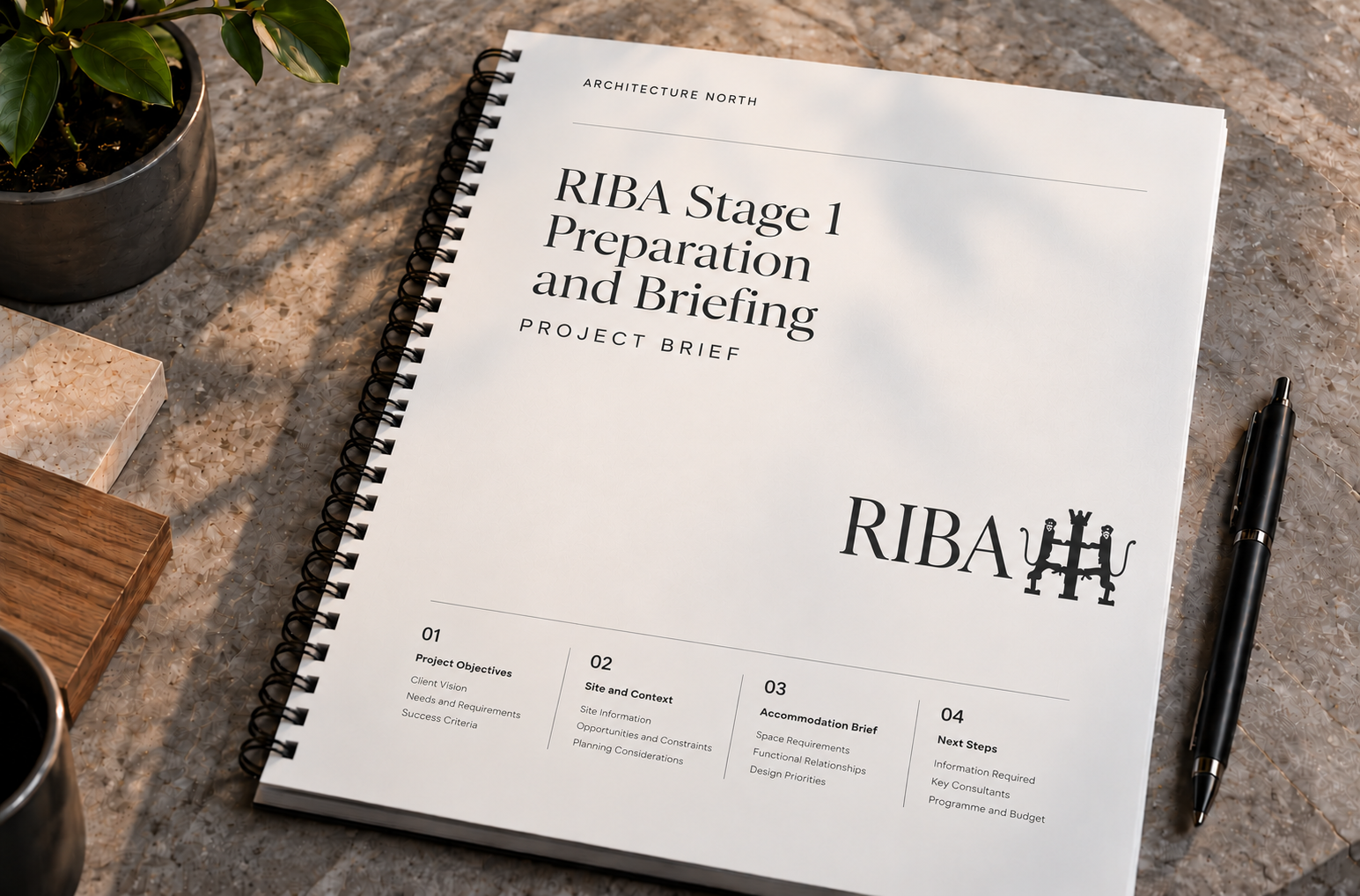
Once the strategic requirements and preferred approach have been established, the project can progress to RIBA Work Stage 1 – Preparation and Briefing.
This stage develops the Project Brief and prepares the information needed for the subsequent design process.
Why Is RIBA Work Stage 0 Important?
It provides an opportunity to evaluate the project before substantial design commitments are made, resulting in greater clarity, better informed decisions, improved financial awareness and a stronger project foundation.
Next Step
RIBA Work Stage 1 -
Project Preparation and Project Briefing.
Once the strategic requirements have been established, the project progresses to Stage 1, where the Project Brief is developed and the information needed for design is prepared.